
The problem with "normal people"
Almost all of politics assumes there is a "normal person". What if there is not?

It is never going to be my policy to share content produced for my blog on this Substack. It is my intention that they should have a slightly differing focus. However, all rules have to be broken on occasion and I felt this lengthy essay, which I first published yesterday, was worth sharing here because I think it represents a major development in my own thinking on the politics of care.
The reappraisal of ‘normal’
The last week has been fascinating, but understanding what is happening in the UK at present requires that events be appraised from a seemingly unusual perspective.
Alan Milburn says Britain has a crisis because around a million young people are not in employment, education or training.
Tony Blair says the government must adapt itself to artificial intelligence.
Reform says Britain needs to recover traditional values and a stronger sense of national identity.
At first sight, these ideas appear to have little in common. One is concerned with young people, one with technology and one with culture. Yet I think they are all responses to the same problem. More importantly, I think they are all trapped within the same intellectual framework, even though they point in very different political directions.
Adolphe Quetelet
To explain why, I need to introduce a man most people have never heard of.
He was Adolphe Quetelet, a Belgian mathematician and statistician who lived between 1796 and 1874. He is rarely mentioned outside specialist circles now. I came across him in Robert Chapman’s book Empire of Normality: Neurodiversity and Capitalism. I think there is a strong argument that he helped create one of the most influential ideas in modern political history.
The observation that made him famous was, in itself, entirely unremarkable. Looking at large populations, Quetelet noticed that many human characteristics clustered around an average. Height did. Weight did. Physical measurements of all sorts did. Given enough observations, patterns emerged that could be described statistically.
There was nothing especially controversial about that. It was a description of reality. People vary, but they do so within limits. Once large enough numbers are involved, averages appear.
The significance of Quetelet’s work lay not in the observation itself but in what happened to it afterwards.
From description to prescription
What had begun as a statistical description gradually acquired social significance.
The average person became defined as the normal person.
The normal person then became the desirable person.
Before long, institutions began to organise themselves around assumptions about what such a person should be.
What had started as mathematics slowly became morality.
That transformation occurred at exactly the moment when industrial society was emerging:
Governments were becoming larger and more sophisticated.
Public education systems were being created.
Factories were employing vast workforces.
Cities were expanding rapidly.
Entire populations were increasingly being organised through institutions that depended upon standardisation.
And for all these new organisations, the idea of normality proved extraordinarily useful.
Schools could be designed around assumptions concerning how children learned.
Employers could make assumptions about how workers behaved.
Administrators could create systems based on expectations about what citizens might do.
Doctors could compare patients against established norms.
The concept of the normal person provided a benchmark around which an increasingly complex society could organise itself.
Let me stress, this was not necessarily or entirely a bad thing. Large-scale institutions do require generalisations. No education system can function without assumptions about learning. No healthcare system can function without assumptions about health. No government can function without categories and classifications.
An issue did emerge, though. The problem arose when averages ceased to be descriptive and became prescriptive.
An average tells us what is common. It does not tell us what is desirable. Yet the distinction between those two ideas became increasingly blurred. The normal person was no longer simply a statistical construct. The normal person became an aspiration.
As a result, people increasingly came to be judged according to their proximity to a norm. Those who approximated to it were regarded as successful. Those who diverged from it increasingly became subjects of concern.
The consequences of this shift can be found throughout modern society:
Educational systems identify those who do not fit expected learning patterns.
Labour markets classify those who do not participate in expected ways.
Public policy increasingly categorises citizens according to their relationship with social norms.
Sometimes this has undoubtedly been beneficial. Public health programmes, mass education and social security systems all relied upon the capacity to understand populations at scale. But the same process also encouraged a particular way of thinking about human beings:
People increasingly became problems to be solved.
Differences increasingly became deviations to be explained.
Variation increasingly became something that institutions sought to manage.
The more I look at modern politics, the more I think we still live within the world Quetelet helped create, with all the problems that have flowed from it.
The language might have changed, but the assumptions that flowed from Qutelet’s work remain remarkably familiar. For example, when politicians talk about:
working people,
hard-working families,
productive citizens,
employability,
social mobility or
educational attainment,
they are frequently doing more than describing reality. They are implicitly comparing people with an imagined norm. They are invoking a model citizen against whom success can be measured.
That model citizen is rarely described explicitly. Most of the time, we are simply expected to know who they are.
The reason this matters is that much of twentieth-century politics can be understood as an argument about how best to create that model citizen. The political right and the political left might have claimed to disagree profoundly about ownership, markets, the state, and the distribution of power, and maybe they did disagree in that way in my youth. Despite that, they have shared a surprising amount of common ground when it came to assumptions about expertise, administration and social improvement. Both have always believed:
that society could be improved,
institutions could help achieve that improvement,
outcomes of change could be measured, and
progress involves bringing more people closer to an accepted social norm.
That common thinking has shaped almost every major political movement of the last century. It also helps explain why so many of our current political debates feel simultaneously intense and strangely unsatisfactory. The argument is presented as a conflict between competing visions of society. In practice, I now wonder whether it is actually a dispute between competing definitions of normality.
Gates, Fabianism and the management of society
The more I have thought about this issue, the more I have come to suspect that much of twentieth-century politics was conducted within a framework that neither side seriously questioned.
The great political battles of the age were real enough. There were arguments about:
ownership,
taxation,
welfare or social security (depending on perspective),
public services,
labour rights, and
economic management.
They still matter. But beneath those disputes lay a deeper agreement about the nature of society itself. Both left and right increasingly came to believe that society could be improved through expertise, which meant that:
social problems could be identified through research,
institutions could be designed to produce better outcomes,
progress could be measured, and
there were broadly accepted norms against which that progress might be judged.
The differences between the sides in the debate concerned who should undertake this work, through which institutions it should be undertaken, and to whom that work should be accountable.
The right increasingly gravitated towards a model associated with Frederick Taylor Gates.
Gates, like Quetelet, is now largely forgotten, but in many respects, he was one of the architects of modern philanthropy. He worked with John D. Rockefeller. Doing so, he helped pioneer the idea that private wealth could be used systematically to reshape society through large-scale institutions devoted to education, medicine, public health and research. This resulted in the Flexner Report, which has shaped the history of modern medicine since its publication in 1910. I have already considered the consequences of that report here.
The significance of Gates lay not simply in his belief that social problems could be solved. Many people believed that. What distinguished him was his conviction that solutions could be designed, tested and implemented by experts operating through carefully constructed institutions. This was not charitable in the traditional sense. It was deliberate social engineering. The argument he and Rockefeller put forward was that their purpose was not simply to alleviate suffering but to improve society itself, albeit in the way their philanthropy desired. They defined the terms. The theme remains familiar today.
The beneficiaries of this approach were often real enough. Universities expanded. Medical research was advanced. Public health improved. There is no point pretending otherwise. Yet the underlying assumption remained that experts could identify desirable outcomes and then create institutions capable of delivering them.
The Fabian tradition, founded in the UK in 1884, shared much of this outlook. Sidney and Beatrice Webb are often remembered as architects of the welfare state and important influences on modern social democracy. Their politics differed profoundly from those associated with Rockefeller philanthropy. Yet their intellectual assumptions were often remarkably similar. The Fabians also trusted expertise and research, and believed that institutions could be designed to improve society, whilst believing that social progress could be planned.
There was, however, a difference between their thinking. Where Gates looked to foundations, philanthropy and philanthropists as those to whom those promoting social change should be accountable, the Fabians looked to the state.
Where Gates relied upon private wealth, the Fabians relied upon public authority.
But both traditions saw society as something that could be managed. Both believed that intelligent administration could improve outcomes. Both placed extraordinary faith in the capacity of institutions to shape human behaviour. The similarities and differences can perhaps be summarised like this:
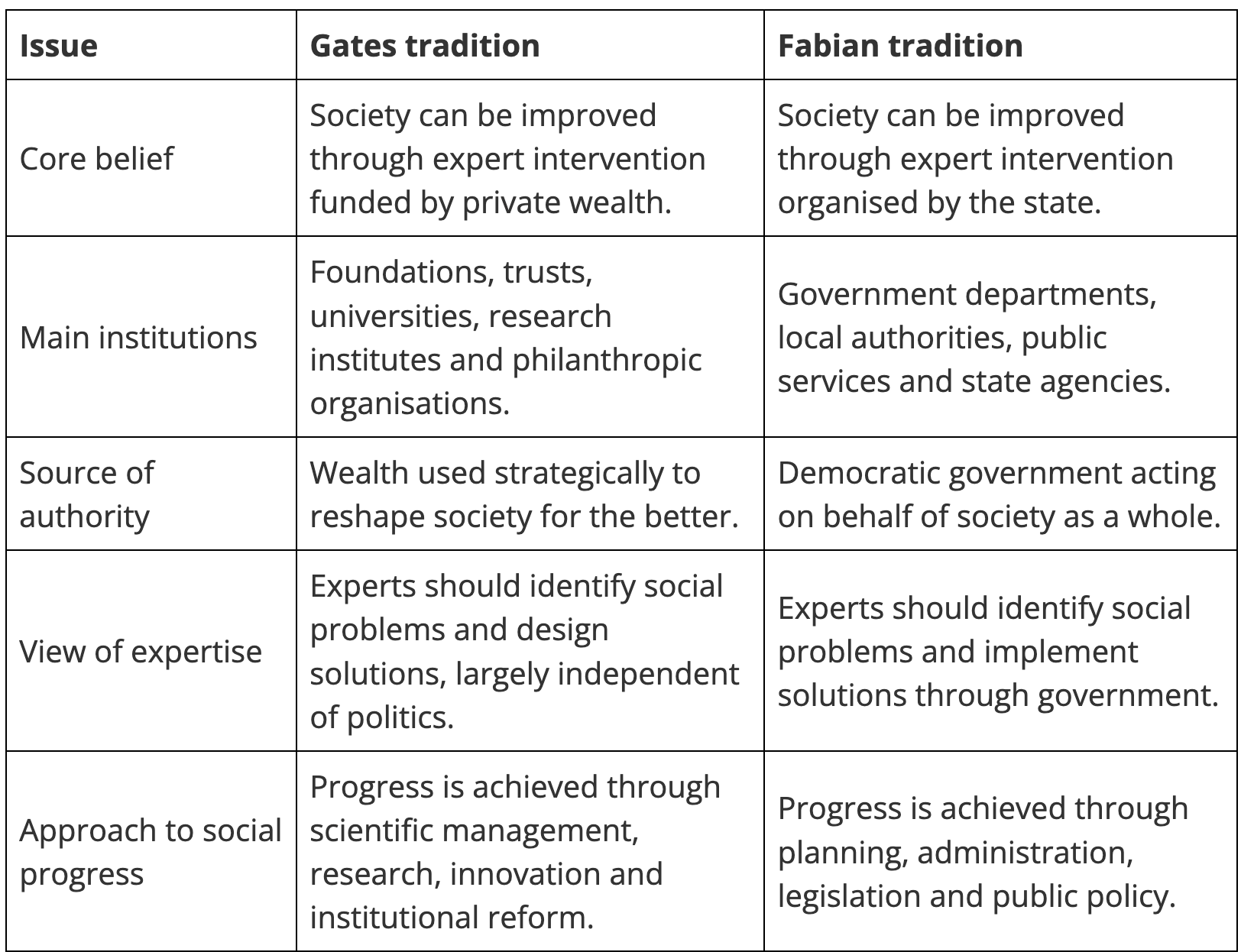
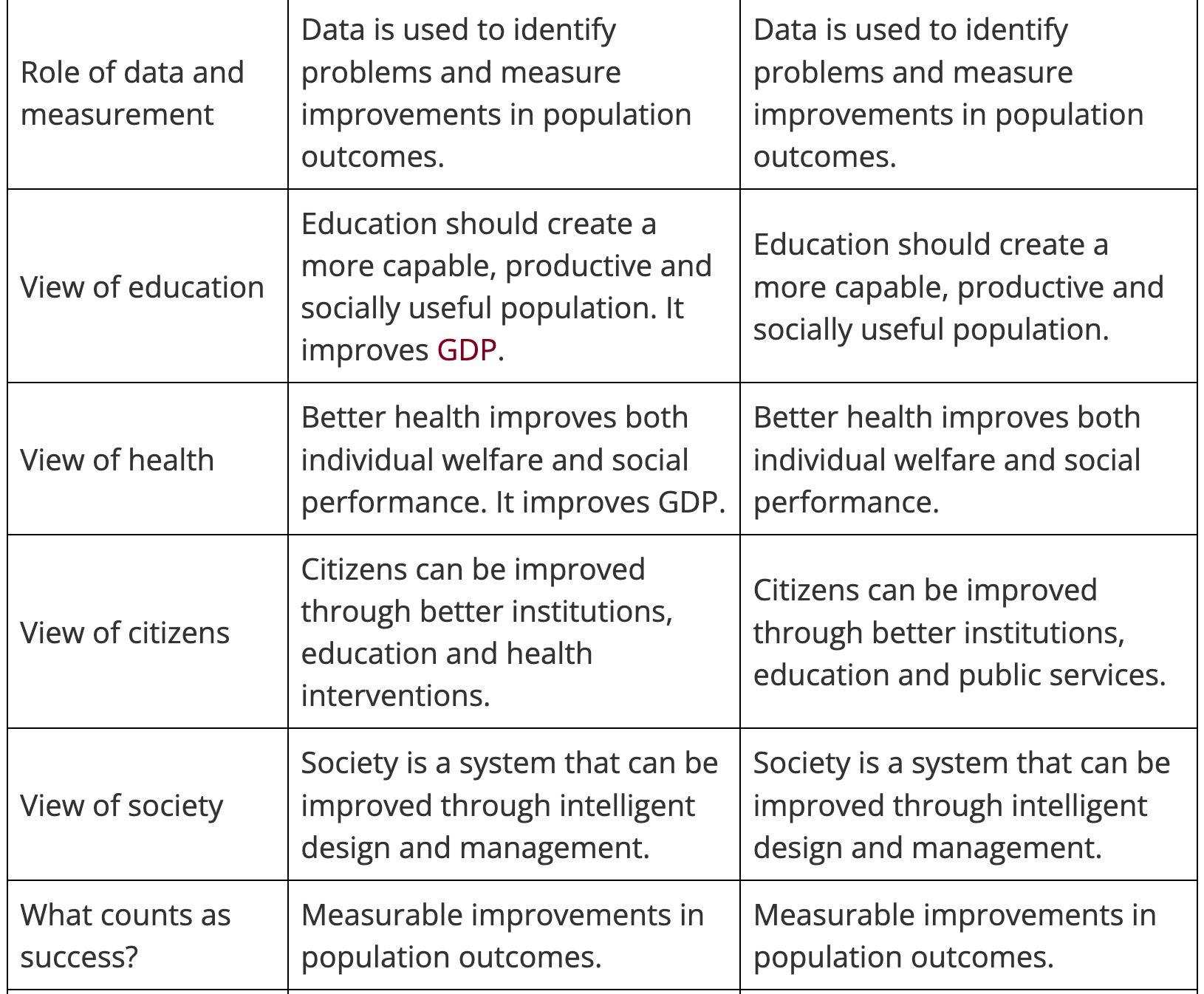
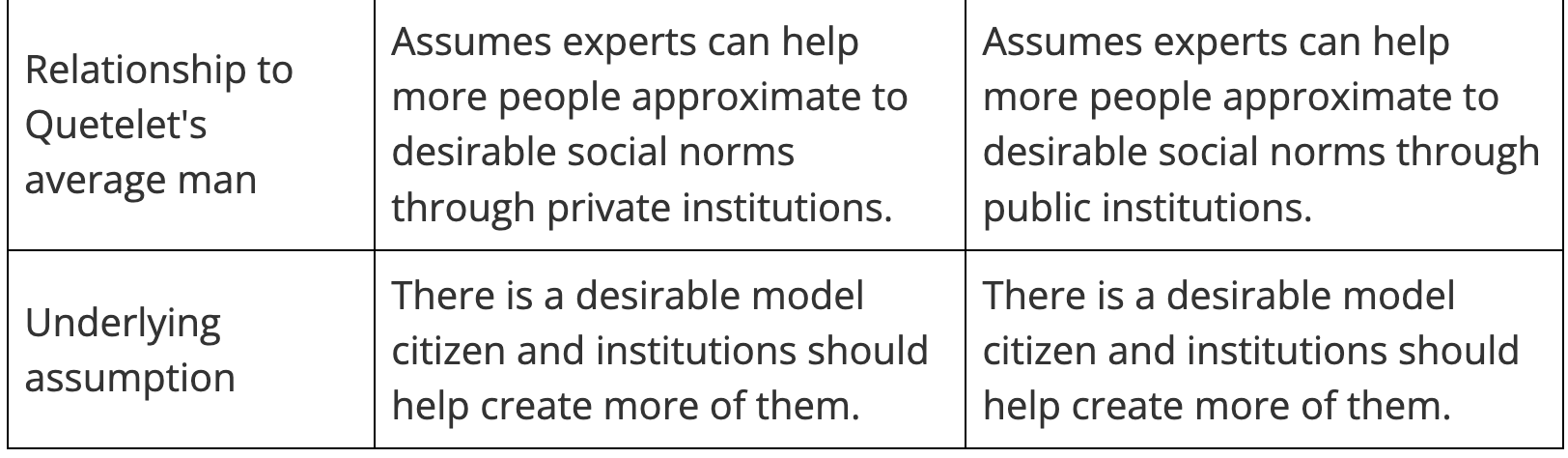
The table is, of course, a simplification. No historical tradition is ever quite as tidy as a table suggests. Nonetheless, I think it captures something important.
The great political argument of the twentieth century was often not about whether society should be administered. It was about who should administer it.
The right trusted philanthropic institutions and private expertise.
The left trusted government and public expertise.
But both trusted expertise, both trusted administration, both trusted measurement, and, most importantly, both trusted norms.
Both assumed that there were desirable social outcomes, that institutions could encourage people towards them, and that progress could be judged against accepted standards.
When measurement replaces meaning
The consequence was clear. Both left and right believed they could change society by advancing normality, but they sought to do so with different emphases. The result was that politics often became less concerned with what it means to live well and more concerned with how the outcomes chosen by experts might be improved.
That distinction may sound abstract. I do not think it is.
As politics became primarily concerned with outcomes, people inevitably began to appear as variables within systems. The consequences were obvious:
Success supposedly became measurable.
Failure became measurable.
Behaviour became measurable.
Citizens became data points.
This did not happen because politicians were malicious. It happened because institutions naturally favoured what could be counted. And what could be counted tended to become what mattered.
That tendency can still be seen everywhere now:
Educational attainment is measured.
Economic productivity is measured.
Employment rates are measured.
Public service performance is measured.
Governments celebrate improvements and lament declines.
We are still in the “shut up and calculate “ era in thinking on many of these issues.
None of this is irrational. Indeed, much of it is entirely sensible. The difficulty arises when measurement begins to substitute for meaning:
Improving outcomes is not the same thing as understanding what those outcomes are supposed to achieve.
Raising productivity is not the same thing as understanding what economic activity is for.
Increasing educational attainment is not the same thing as understanding what education is for.
Improving employability is not the same thing as understanding what work is for.
The distinction is easy to miss because the language of administration has become so familiar. Yet I think it matters enormously. Once politics becomes primarily concerned with improving outcomes, it begins to lose sight of the question that Aristotle long ago regarded as central. He asked what I think to be a critical question, which is what does it mean for human beings to flourish?
That question almost disappeared from political discourse during the twentieth century. Instead, politics became increasingly concerned with targets, outputs, outcomes and performance. The result was a world in which both left and right often appeared to argue about means whilst quietly agreeing on ends, which is why the convergence of modern politics around seemingly similar themes has become so commonplace. The result is the ‘single transferable party’, often referred to on this blog, which has arisen because our major political parties have almost indistinguishable operational goals, despite whatever they say about ideological differences.
The normal citizen is supposedly at the centre of both projects. The only difficulty was that, in both projects, the citizen in question was often an abstraction and not a real person with all the complexity, diversity, and unpredictability that real people possess, but instead something much closer to Quetelet’s average person, translated into political form.
And it is precisely the assumption that this is an adequate basis for modern political thinking and delivery that is now being challenged.
When the normal person disappears
What, then, has changed? Why does a way of thinking that appeared so secure for more than a century suddenly seem much less convincing?
There is no single answer to that question. Social change never has a single cause. Nonetheless, one development strikes me as especially important because it challenges the very foundations upon which so much twentieth-century thinking was built. That development is the growing recognition that there may be no such thing as a normal person.
At first sight, that might seem a strange claim. After all, averages do exist. We can calculate average incomes, heights, life expectancies, and educational attainment. Statistical distributions have not disappeared. The issue is not whether averages exist. The issue is whether averages tell us anything useful about what people ought to be. Increasingly, many people suspect they do not. I agree with them.
The challenge has emerged from a variety of directions.
Feminism questioned assumptions that had long treated male experience as the norm.
Disability campaigners challenged institutions that assumed physical conformity.
Minority groups challenged cultural assumptions presented as universal.
More recently, debates about neurodivergence have raised similar questions regarding cognition, learning, communication and behaviour.
What all these developments have in common is that they challenge the authority of the norm.
For generations, difference was frequently interpreted as deficiency. Those who diverged from accepted standards were assumed, almost automatically, to possess characteristics that required explanation. The benchmark was rarely questioned. The individual was. Increasingly, that relationship has been reversed. Instead of asking why individuals differ from institutions, people have begun asking why institutions were designed around particular assumptions in the first place.
That is a profoundly important shift. An educational system that struggles to accommodate dyslexic pupils may reveal something about dyslexia. It may also reveal something about the assumptions embedded within education.
A workplace that rewards particular styles of communication whilst disadvantaging others may reveal something about individual employees. It may also reveal something about the norms around which workplaces have been organised.
A society that assumes there is a single desirable route through education, employment and social participation may reveal less about its citizens than it does about the limits of its own imagination.
The significance of this change extends far beyond neurodivergence itself. What is being questioned is not simply whether particular groups have been misunderstood. What is being questioned is whether the search for a model citizen was ever a sensible project in the first place. The more one looks at human beings, the more difficult it becomes to sustain the idea. People differ enormously:
in personality
in ambition
in capability
in motivation
in learning style
in values
in the way they construct meaning in their lives, and, perhaps most importantly of all,
in what enables them to flourish.
That final point matters because it takes us back to the distinction between administration and purpose. The Gates tradition, ostensibly, and the Fabian tradition, more probably, sought to improve society, albeit paternalistically, which remains a major problem for the left. Their achievements were often substantial. But they largely shared a tendency to treat human beings as objects of policy rather than as subjects pursuing lives of their own choosing. That was inevitable: both ideologies were paternalistic in their approach
Saying so, I do not mean that Gates, the Webbs or their successors were entirely indifferent to human welfare. That is not true. They wanted people to live better lives. The problem lay elsewhere. They tended to assume that they alone knew what those better lives should look like and created policy in the image of their assumptions, rather than in that of those people who were to be subject to it.
That approach is much harder to sustain today. The growing recognition of human diversity makes it increasingly difficult to believe that there is a single model of success towards which everyone should aspire.
That is why so much contemporary politics feels strangely unsatisfactory. The old language continues to be used, but it no longer resonates as it once did.
Politicians talk about working people, but who are they?
They talk about hard-working families, but which exactly are those?
They talk about ordinary people, but ordinary according to whom?
They talk about aspiration, but aspiration towards what?
Again and again, the language invokes a norm without ever defining it. And that is because the norm has become increasingly difficult to define.
Three politicians, one framework
This is where contemporary political debates become particularly interesting.
Take Alan Milburn’s concern, reported this week, about young people who are not in employment, education or training. The issue he identifies is real. Large numbers of young people appear disconnected from institutions that most of us regard as important. But notice how the category works. A young person becomes defined by absence:
they are not employed,
not in education, and
not in training.
The concern is understandable, but the assumption is revealing. The assumption is that participation in these systems is the benchmark against which success should be measured. Those benchmarks indicate normality. The possibility that some people may seek different routes through life receives comparatively little attention or is dismissed outright. The objective of Milbrun’s proposal is to integrate the so-called NEETs (those not in employment, education, or training) into existing structures. The structures themselves are largely taken for granted.
Tony Blair’s recent writing reveals a similar tendency. His concern is not really with artificial intelligence. His concern is with administration. He is asking:
How can institutions become more effective?
How can government become more productive?
How can technological innovation improve outcomes?
These are not unreasonable questions. Yet they remain questions about systems. They are not questions about purpose.
The assumption is that improving the efficiency of existing institutions is self-evidently desirable.
What is discussed far less frequently is whether those institutions are pursuing the right goals in the first place.
The citizen who emerges from Blair’s essay is, in many respects, a familiar figure:
adaptable,
economically engaged,
productive, and
capable of functioning successfully within increasingly sophisticated systems.
In other words, they are recognisably descended from Quetelet’s normal person.
We then need to add another dimension to this discussion, assuming that Labour and the Conservatives are now, in effect, a single transferable party with little to differentiate them, as much of the UK population would seem to think. Reform appears, at first sight, to offer something very different.
Its language is not that of administration.
It uses the language of identity, belonging and recognition.
Its appeal lies partly in its rejection of technocratic assumptions.
Many of its supporters feel alienated by institutions that appear distant, managerial and unresponsive.
They are tired of being measured, categorised and managed.
Yet my suggestion is that Reform is not escaping the logic of normality. It is merely redefining it.
The productive citizen becomes the patriotic citizen.
The adaptable citizen becomes the self-reliant citizen.
The administratively successful citizen becomes the culturally approved citizen.
The content changes. The structure remains.
Once again, a model person appears. Once again, politics becomes a process of encouraging people towards that model. That, I think, is why so much contemporary politics feels trapped. The participants appear to disagree profoundly. In reality, they are often arguing about competing definitions of the same thing. The normal person remains at the centre of the debate. The possibility that there is no such person rarely enters the discussion at all.
And yet it is precisely that possibility that increasingly confronts us.
The more we recognise the diversity of human experience, the harder it becomes to believe that flourishing can be reduced to conformity.
The more we understand difference, the less convincing normality becomes.
And once that realisation begins to take hold, a very different question starts to emerge. If politics is not about creating normal people, what is it actually for?
Beyond normality
That question takes us beyond Quetelet, beyond Gates, beyond Fabianism, beyond Blair and beyond Reform. It takes us to a debate that is much older than any of them. In many ways, it takes us back to Aristotle.
Aristotle did not ask what was normal. He was not interested in averages. Nor was he especially interested in conformity. His central concern was the purpose of human life, the telos as he called it, and the role that society should play in helping people achieve it. His answer was remarkably simple. Human beings flourish, or at least they can flourish. The purpose of society is to help make that possible.
This is a profoundly different way of thinking about politics. If politics is organised around normality, then the task of institutions is to encourage people towards an accepted norm. Success is measured by conformity. Difference becomes problematic because it represents distance from an assumed ideal.
If politics is organised around flourishing, the whole perspective changes. The question is no longer whether people conform. The question becomes whether they are able to become what they are capable of becoming.
That is a teleological question. It is concerned not with what people are, but with what they might become. The distinction matters because flourishing is inherently plural.
There is no single route to a good life.
There is no single model citizen.
There is no universal template for success.
Different people possess different talents, aspirations, and capacities. They will therefore flourish in different ways.
A society organised around flourishing does not seek to eliminate those differences. It seeks to make them possible.
That is why I think Aristotle ultimately provides a more useful guide to politics than either Quetelet or, come to that, Nietzsche, who also rejected the idea of normality when writing at around the same time as both Gates and Webb.
Nietzsche understood something important. He recognised that conformity could become oppressive. He saw the dangers of allowing averages to become ideals. He challenged the tendency of societies to reward obedience and punish difference. In that sense, he was one of the first great critics of the world Quetelet helped create.
But Nietzsche’s answer was largely individual. His concern was agency, self-creation, and the capacity of individuals to transcend social expectations. But that leaves an obvious question unanswered. How do people acquire the capacity to do these things? The answer requires asking how they:
develop confidence
acquire education
gain security
obtain healthcare
find the time and space necessary to develop their abilities.
Agency matters, of course. I often argue that. But agency does not emerge from nowhere. It is enabled. Human beings flourish because social conditions allow them to flourish. That is why Aristotle remains important. He understood that politics is not merely about freedom from constraint, as libertarians would have it. It is also about creating the conditions within which people can become fully human.
The question of purpose
That insight feels especially relevant at the present moment because so much contemporary politics has become detached from questions of purpose.
The debate about artificial intelligence illustrates the problem perfectly. When Tony Blair discusses AI, the focus is overwhelmingly upon efficiency, framed almost entirely in a mould that Gates and Rockefeller would clearly recognise. The questions he asks are:
how institutions can function more effectively,
how government can become more productive, and
how systems can be optimised.
These are not foolish questions. But they are very obviously incomplete questions.
The more important question is the one Pope Leo XIV has begun to ask, when also looking at AI, which is what are human beings for?
That question sits at the centre of this entire debate. If the purpose of society is efficiency, then optimisation becomes the obvious goal.
If the purpose of society is flourishing, then efficiency becomes merely one consideration amongst many.
The distinction is crucial:
A perfectly efficient society might still be a profoundly unhappy one.
A perfectly efficient education system might still fail to help people discover their talents.
A perfectly efficient labour market might still leave millions feeling alienated from the work they perform.
A perfectly efficient economy might still fail to provide meaning, purpose or belonging.
The question of purpose cannot be avoided indefinitely. Sooner or later, politics must decide what it is trying to achieve.
For much of the twentieth century, that question was hidden behind assumptions about normality. The normal citizen was assumed to know what success looked like. The role of institutions was therefore to help people move closer to that condition.
Increasingly, that framework appears exhausted because people no longer accept common definitions of:
success,
family,
work, or
identity.
The assumptions that once held industrial societies together have weakened.
That is why Gramsci’s famous observation in his Prison Notebooks now feels so relevant. The old world, as he suggested, is dying. The new world, however, is struggling to be born.
The old world was the world of normality, created by Quetelet, institutionalised by Gates and the Fabians, modernised by Blair and all the heirs of Thatcher, and challenged by Reform. It was a world organised around assumptions concerning what people should be.
The new world has not yet fully arrived. But we can perhaps glimpse its outline. It begins by abandoning the search for the normal person, by recognising that diversity is not a problem to be solved, by accepting that flourishing takes many forms, and by asking what social arrangements are required if people are to realise their potential.
The politics of care
That, it seems to me, is where the politics of care enters the story.
The politics of care about which I write is not simply another political programme. Nor is it merely a more compassionate version of existing politics. It starts from a different place altogether. Its central question is not how people can be made more productive, more patriotic, more employable, or more normal. Its question is how people can flourish.
That is why care is not, in this context, about paternalism. Nor is it primarily about vulnerability. Care matters because it enables human potential. Care creates:
the conditions within which agency becomes possible.
the security that makes risk-taking possible.
the confidence that makes creativity possible.
the education that makes learning possible.
the health that makes participation possible.
the relationships that make meaning possible.
In other words, care is not an alternative to agency. Care is what makes agency possible. You cannot have agency without care.
This is where the politics of care departs fundamentally from the traditions that preceded it.
The Gates tradition sought to improve populations, whilst extracting value from them.
The Fabian tradition sought to improve citizens but created a new technocratic political class obsessed with process rather than content, as is now very apparent.
Blair and the heirs to Thatcher seek to improve systems.
Reform seeks to restore identities.
The politics of care seeks to enable flourishing. That is not a small difference. It is a completely different understanding of what politics is for.
The old politics asked how society could create better versions of normal people.
The politics of care asks how society can help diverse human beings become what they are capable of becoming.
That, I think, is the new world Gramsci sensed struggling to be born. Whether it succeeds remains to be seen. But if the idea of the normal person is indeed reaching the end of its useful life, then it seems to me that politics will need a new organising principle. Flourishing may be the best candidate we have. And a politics of care may be the means by which it can be achieved.
This essay would not and could not have existed without the contribution of Jacqueline Murphy, who also edited it.
THANK YOU!
Probably one of your most important essays ever. Good that you bring in an historical perspective.
This harks back to what I was saying in an earlier post, about the absurd assumption that all children are highly skilled and capable of looking for a job as soon as they finish school, as if magically that selfish drive for one-up-manship (which is what a CV is) just appears out of nowhere.
I always resented that, but had no outlet for expressing it, and indeed, no coaching in how to express it.
I've never been normal, and am quite proud of that now, but back at the end of the school days it was a cause of depression. There was no explanation of why things - societal norms & expectations - were as they were (and are), and certainly no training, and more importantly, no alternatives offered.
I'm not particularly ambitious, which I quickly found goes against most societal norms, especially the further up the food chain you go. Now it's almost a criminal offence.
I never wanted to work at some bullshit job (a la David Graeber), I suspect most people are the same. They say they want a job because that is the only narrative they have been taught. What they actually mean, they (and I) want to flourish, to thrive.
Can you imagine going into the DWP job centre and actually saying I don't want a job, they'd probably get security to throw you out!
Ugh!
I tried being normal for 20 years, which was a disaster mentally. Have now been successfully self-employed for 19 years, writing, painting and gardening, but it should not have taken a mental health crisis at 45 to get there. And that is the brutal outcomes of trying to fit square pegs into round holes, an epidemic of mental health crises.
Of course, those NEETS can clearly see that "working for a living" has stopped even pretending to be a mode of thriving or flourishing, the rentier extraction of neo-liberalism has destroyed working as a concept for many people. That doesn't mean they want to sit around watching TV, smoking dope and tearing up the place on illegal scambler bikes, they want to do. Whatever doing is. Unfortunately they haven't been given the mental models to describe that, the language, the societal narrative, nor any plausible alternatives other than some bogus tick-tok influencers telling them to man up and side hustle.
In that sense, nowt has changed, looking back on my own experience, other than the scale of the problem.
How then, to do a cultural change from a resource-extraction economy to a flourishing/well-being economy?
Goodhart's law, scaled up to a whole country. The average person was a description until politics made it a target, and the moment it became the target it stopped describing anyone and started prescribing everyone.
The single transferable party falls out of that for free. Whoever wins inherits the same statistics and targets, and instruments bend behaviour harder than intentions do, so opposite values converge on identical conduct. The norm sits downstream of the metric, not the manifesto.