

In the latest instalment in my Understanding Economics series, I ask what microeconomics is really about.
Conventional economics usually puts markets at the centre of the answer. It assumes that individuals make rational choices and that markets, operating through prices, allocate resources efficiently. But that account leaves out much of what actually shapes economic life.
None of us makes economic decisions in isolation. Families, communities, businesses and governments all influence the choices available to us. Governments also create the laws and institutions that make markets possible in the first place. Property rights, contracts and money do not simply appear naturally. Markets are social institutions created within society.
Power matters too. Wealth changes the choices people can make, while large companies can exercise considerable market power. And many things that are economically important, including unpaid care and voluntary work, never appear in market transactions at all.
Markets can also fail to account for environmental damage and other costs imposed on society. That is why prices and values are not the same thing.
In this episode of Understanding Economics, I explain why microeconomics needs to look beyond markets. It should ask how society allocates resources, who has power, who bears the costs, who receives the benefits, and how we can organise the economy so that everyone has the opportunity to live well and thrive.
This infographic supports the video:
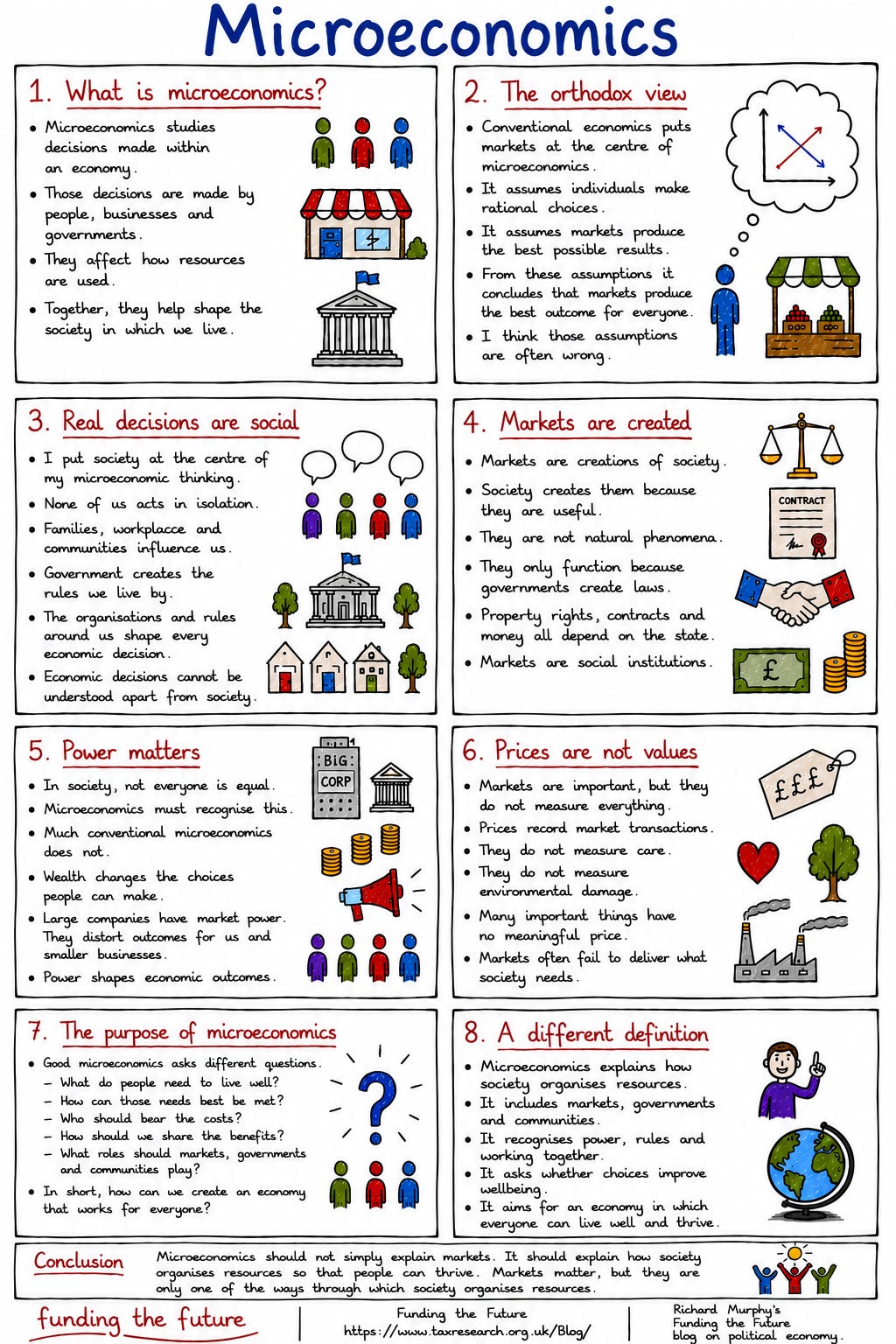
I wrote this infographic, as I did the video. AI drew it, directed by me, just as my AI-assisted camera filmed the video, directed by Tom, my videographer.
Another excellent Infographic!
I think Richard Murphy is performing an important service by explaining economics in terms that the layman can understand and by giving us the vocabulary needed to articulate our concerns more effectively. The general public is unlikely to plough through academic papers/scientific reports and I very much doubt the majority of our politicians do either, even those which are part of their brief. They too need to understand the vocabulary in order to hold the "academic consensus" to account. It is all to easy to bamboozle when your audience is unfamiliar with the vocabulary being used. The consequences of current economic orthodoxy are plain to see and its negative effects are primarily being felt by ordinary people who need to be able to hold those responsible to account.